W.G.A. Ecoregions
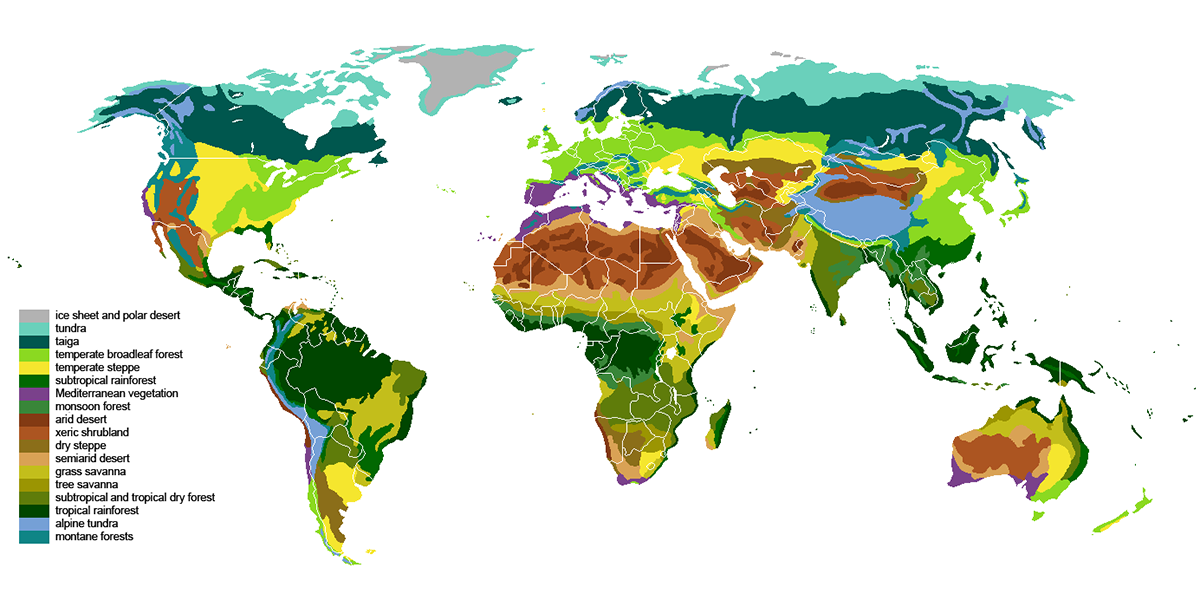
The Wilderness Guides Association uses the Walter Biome system as a functional framework for defining ecoregions and structuring professional Wilderness Guide specializations.
Why Ecoregions Matter for Wilderness Guides
Level 2 and Level 3 certifications are ecoregion-specific because different environments require different operational competence. Climate, terrain, remoteness, logistics, leadership and safety considerations vary significantly between biomes.
While many guiding skills are transferable, professional responsibility increases when operating in unfamiliar environments. The Walter Biome system provides a globally recognised and practically applicable reference for categorising these conditions.
Ecoregions Overview
🌲 Boreal / Nemoral
Forest-dominated regions with strong seasonal variation and multi-modal travel.
Open Boreal ecoregion
❄️ Arctic
Cold, treeless and exposed environments with high operational consequence.
Open Arctic ecoregion
🌴 Tropical / Jungle
Warm, humid environments with dense vegetation and high biological complexity.
Open Tropical ecoregion
🏜️ Desert
Arid regions where water management, heat exposure and long-range planning are critical.
Open Desert ecoregion
The Walter Biome System
The Walter Biome system classifies global ecosystems based on climate, seasonality and vegetation structure. For wilderness guiding, this provides a clear link between environmental conditions and professional competence.
Boreal / Nemoral
Walter VIII – Boreal and Walter VI – Nemoral
Arctic
Walter IX – Polar
Tropical / Jungle
Walter I – Equatorial and Walter II – Tropical
Desert
Walter III – Subtropical Desert and Walter VII – Continental Desert
Professional Pathway
Each ecoregion links directly to WGA Level 2 and Level 3 standards. Together they form the environmental backbone of the WGA certification framework.